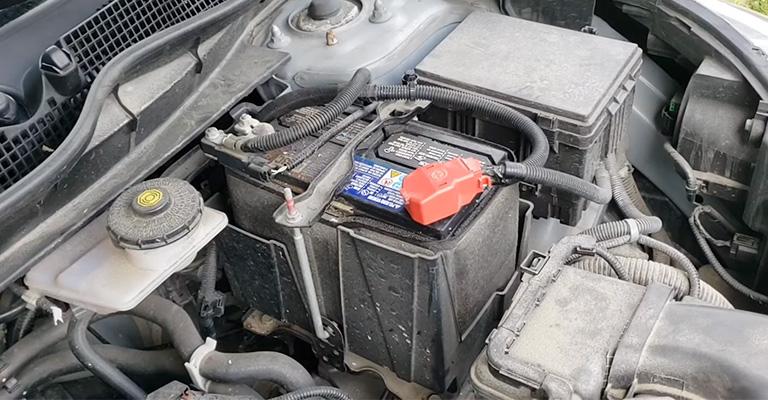
Modern Toyotas are packed with smart technology, but when a warning light pops up, it can feel like a mystery. That’s where an OBD2 scanner comes in—your gateway to understanding what’s really happening under the hood.
Whether you’re a DIY enthusiast who loves tackling maintenance at home or a driver who simply wants peace of mind, the right scanner can save time, money, and stress.
Best OBD2 Scanners for Toyota
In this guide, we’ll highlight the Top 9 Best OBD2 Scanners for Toyota, helping you choose the perfect tool to diagnose issues, monitor performance, and keep your car running smoothly.
9. MOTOPOWER MP69033 OBD2 Scanner

The MotoPower MP69033 is a surprisingly capable little device that plugs straight into your car’s OBD‑II port and turns your dashboard into a diagnostic hub.
I’ve used it on a 2010 Honda Civic and a 2008 BMW 3‑Series, and the results were consistently clear and actionable.
The built‑in DTC lookup library means I never have to flip through a manual to understand a fault code, the scanner explains it in plain language.
I appreciate that it pulls real‑time data like engine speed, coolant temperature and load value, which gives me a live picture of how the car is performing.
The 2.8” LCD is bright enough to read even in sunlight, and the white backlight keeps it readable at night. No batteries or extra power sources needed – the scanner draws power directly from the car’s OBD‑II connector, so it’s ready to go as soon as you plug
8. XTOOL IP500 OBD2 Scanner for Toyota

The XTOOL IP500 feels like a dealership’s diagnostic console in the palm of your hand. Its 5‑inch HD touchscreen is crisp and responsive, making navigation a breeze even during a deep scan.
The 1.2 GHz dual‑core processor keeps live data streaming without lag, so you can watch engine and transmission graphs in real time and spot subtle performance drops before they become major issues.
The 21 Toyota‑specific functions—EPB reset, ABS bleeding, injector coding, and more—turn a generic OBD‑II reader into a full service tool that can actually fix problems rather than just report them.
And with a lifetime free Wi‑Fi update, the device stays current with new models and firmware without extra cost.
Pros
- Intuitive touchscreen interface delivers dealership‑level diagnostics at home.
- Bi‑directional control lets you test lights, wipers, and actuators on the fly.
- 21 exclusive Toyota functions mean you can reset, calibrate, and code without a shop.
- Lifetime free updates keep the tool compatible with the latest models.
Cons
- Battery life is decent but not all‑day; a charger isn’t included.
- Primarily for Toyota/Lexus/Scion, so other brands need separate tools.
7. VDIAGTOOL VD10 OBD2 Scanner
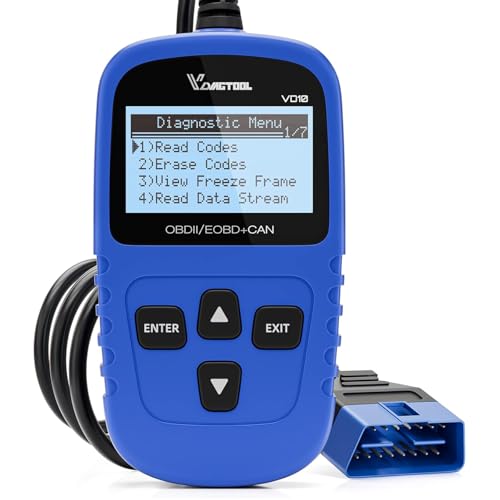
I hooked the VDIAGTOOL VD10 up to my 2015 Corolla’s OBDII port and was instantly greeted by a clear, backlit screen that listed every fault code with its definition.
The built‑in database covers over 3,000 codes, so I never had to Google a mystery P‑code. Clearing the codes was just a tap, and the MIL blinked off in seconds—no more guessing which part was at fault.
The live‑data feed is surprisingly detailed, showing RPM, intake temperature, fuel trims, and misfire counts in real time.
When a check‑engine light came on again, the freeze‑frame data helped me pinpoint the exact moment the fault occurred, making intermittent issues far easier to diagnose.
The I/M readiness check is a lifesaver for annual inspections; I could confirm that all monitors were green before heading to the DMV.
Plug‑and‑play is a major win—no batteries, no charging, just a quick connection to the car’s port. The 2‑line display is crisp, and the backlight can be dimmed for night‑time use. It even pulls the VIN and calibration IDs, handy when inspecting a used vehicle.
Pros
- Rapid, on‑screen DTC definitions eliminate online searching.
- Live data and freeze‑frame capture give deep insight into intermittent faults.
- Built‑in I/M readiness checks make inspection prep a breeze.
- 3‑year warranty and lifetime free updates keep the tool future‑proof.
Cons
- The 2‑line screen can be a bit cramped for complex data streams.
- Some users may miss advanced diagnostics that a full‑size OBDII scanner offers.
6. ANCEL AD410 OBD2 Scanner

The ANCEL AD410 feels like a toolbox that fits in your glove compartment. Plug it into the OBD‑II port, turn the key, and the 2.4‑inch color screen lights up with a clean menu, no manual needed.
It pulls up to 42,000 DTCs instantly, so you can read and clear codes without hunting the internet. The built‑in O2 sensor and EVAP leak tests let you fine‑tune fuel efficiency and catch small leaks before they grow into expensive repairs.
Multilingual support is a plus for anyone driving a European or Asian model, and it runs off the car’s power, no battery or charger required.
The scan covers every 16‑pin OBD‑II protocol, from the classic ISO9141 to the newer CAN buses, so it’s future‑proof for most cars from 1996 onward.
The UI feels modern and intuitive, and the quick‑start guide is straightforward. I’ve used it on a 2012 Subaru and a 2019 Honda, and both times the interface was painless.
Pros
- Lightning‑fast code lookup and clear‑code function—no extra searches.
- Built‑in O2 & EVAP tests improve fuel economy and reduce emissions.
- Wide protocol support covers nearly every 16‑pin vehicle, even newer CAN models.
- No extra battery—runs directly from the car’s power supply.
Cons
- Limited to engine diagnostics; ABS, SRS, and transmission codes are out of scope.
- Requires a Windows PC for firmware updates; not compatible with macOS.
5. FOXWELL NT301 OBD2 Scanner

The FOXWELL NT301 is a solid, plug‑and‑play OBD2 scanner that feels like a professional tool in a compact package.
As soon as you plug it into the 16‑pin port, the 2.8‑inch color screen lights up and the built‑in speaker gives you instant feedback.
It reads DTCs instantly, pulls the VIN, and shows you real‑time sensor data with graphing that’s surprisingly clear for a handheld device.
The e‑missions readiness LEDs (red‑yellow‑green) and a quick reset button for the Check Engine Light make it a handy companion for quick diagnostics at home or in a small shop.
The scanner supports all major OBDII protocols (KWP2000, J1850 VPW/PWM, ISO9141, CAN) and works with most 1996‑present vehicles, including light trucks and SUVs.
The “Vehicle CEL Doctor” function lets you turn off the MIL after a repair, but the code will reappear if the issue isn’t fixed—exactly what you’d expect from a true diagnostic tool.
The device ships fully charged (no battery needed) and comes with a lifetime free update, which is a nice perk for staying current with new models. A built‑in speaker and LED status indicators add a professional touch without extra cables.
Pros
- Plug‑and‑play, no battery or firmware updates required.
- Live data graphing gives instant insight into sensor trends.
- e‑Missions readiness LEDs and quick MIL reset for hassle‑free checks.
- Lifetime free updates keep the scanner future‑proof.
Cons
- Limited to basic OBDII codes; no ABS, TPMS, or advanced systems.
- Requires a functioning OBD port; any wiring issue can cause false negatives.
4. BlueDriver Bluetooth Pro OBDII Scan Tool
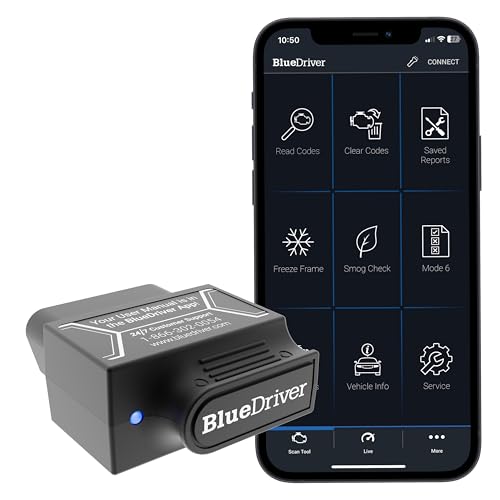
The BlueDriver Bluetooth Pro has turned my garage into a mini repair shop. Plug the sensor into the OBDII port, pair it with my phone, and the app instantly pulls up every trouble code, ABS, airbag, TPMS, you name it, alongside a clear explanation of what’s wrong and how to fix it.
The live‑data feed is a game‑changer; I can watch throttle position, engine RPM, and coolant temperature in real time, so I know exactly when a component is slipping.
I especially love that there’s no subscription fee. One purchase unlocks the full database of repair videos and unlimited repair reports.
The app feels like a mechanic’s handbook on my phone, and the 24/7 support team is quick to answer questions. Wireless connectivity eliminates the tangled cables that usually make a scan tool feel like a toy.
Pros
- Wire‑free design keeps the garage tidy
- Unlimited repair reports with step‑by‑step videos
- Real‑time live data for on‑the‑spot diagnostics
- One‑time purchase, zero subscription costs
Cons
- Battery life can dip during extended use
- Limited to gasoline vehicles (no diesel support)
Overall, BlueDriver delivers professional‑grade diagnostics without the price tag of a dealership tool. It’s the most user‑friendly OBDII scanner I’ve used, and it’s saved me hours of guesswork and a few trips to the mechanic.
3. Creader Elite OBD2 Scanner for Toyota Lexus

The LAUNCH Creader Elite feels like a professional tool in a compact package. The 4‑inch Android 5.0 screen is responsive and the touch interface makes navigating the menu a breeze—no more fumbling with tiny buttons.
AutoVIN instantly pulls the VIN, model, and year, so you skip the tedious manual lookup. The full OE‑level diagnostics cover every module in Toyota and Lexus vehicles, giving you real‑time graphs, freeze‑frame data, and active tests that let you see exactly where the problem lies.
What really stands out is the bi‑directional control. I was able to reset the ABS and perform a crankshaft relearn without pulling the steering wheel or opening the hood.
The “free” reset functions oil reset, gear shift calibration, and brake pad wear—are a major time‑saver for both DIYers and professionals. Plus, the lifetime free updates mean the tool stays current with new model releases without any subscription fees.
The Wi‑Fi sharing is handy; I can email a full diagnostic report to my mechanic with just a tap.
The multilingual support (11 languages) makes it approachable for anyone. The only drawback is that it’s limited to 12‑V vehicles; the 24‑V trucks are out of scope.
Also, while the tool claims lifetime updates, older models sometimes lag a bit behind the latest software releases.
Pros
- Lightning‑fast AutoVIN and intuitive touch interface
- Comprehensive OE‑level diagnostics with live data & graphs
- Powerful bi‑directional control: reset, relearn, and active tests
- Lifetime free software updates, no subscription fees
Cons
- Limited to 12‑V cars; 24‑V trucks not supported
- Some older models may experience delayed update rollouts
2. OBDMATE OM701 OBD2 Scanner

The OBDMATE OM701 feels like a professional tool that’s been trimmed down for the everyday owner.
Plugging it into a 2010 Toyota Corolla is instant, no software, no batteries, just a quick 1‑minute scan that lights up every system on the screen.
The 2.8‑inch display shows live data and graphs, making it easy to spot a sluggish sensor or a stuck code in real time.
What really sets the OM701 apart is the breadth of reset functions. From oil‑change and throttle resets to EPB, TPMS, and even DPF regeneration, the scanner covers almost every routine maintenance task that would normally cost a visit to a dealer.
The “all‑systems” diagnostics go beyond standard OBD‑II codes, pulling in ABS, SRS, and fuel‑trim information that most generic scanners ignore. And with a free, lifetime update policy, the device stays current without a subscription fee.
The kit comes complete with a durable case and a USB cable, and the interface supports five languages, which is handy for non‑English users.
The only real downside is that some advanced features, like steering‑angle calibration, only work on newer models, so older cars may feel a bit limited.
Additionally, while the screen is clear, the interface can feel a touch clunky compared to newer touchscreen scanners.
Pros
- Deep diagnostics across all Toyota systems, not just basic OBD‑II
- Over 15 reset functions that cut dealer costs
- Plug‑and‑play with no setup or battery required
- Lifetime free updates keep it future‑proof
Cons
- Advanced features limited on older models
–
1. ANCEL AD310 OBD II Scanner

The ANCEL AD310 feels like the pocket‑sized mechanic you can keep in your glove compartment.
Plug it in, and within seconds it pulls up the exact emission‑related trouble code that’s keeping your check engine light on. No batteries, no extra cables – it draws power straight from the OBD‑II port, so it’s ready to go whenever you are.
Its 2.5‑foot cable is surprisingly thick and flexible, so you won’t drop it into the engine bay like a flimsy tool.
The screen is large enough to read without squinting, and the buttons are clearly labeled, making navigation a breeze even if you’re new to diagnostics.
The device supports every major OBD‑II protocol (KWP2000, J1850, ISO9141, CAN), so whether you have a 1996 Subaru or a 2023 Toyota it should work – just double‑check with customer service if you’re unsure.
Because it only reads emission‑related codes, it won’t catch mechanical faults that aren’t linked to the emissions system, but for most everyday owners that’s enough.
Its compact size (just 8.9 × 6.9 × 1.4 inches, 12 oz) makes it a great travel companion; you can slip it into a backpack or even leave it on the dash while you drive.
Pros
- Lightning‑fast code read/clear – fixes the light in seconds.
- All‑protocol support means it works with almost any OBD‑II car.
- Durable 2.5‑ft cable keeps it from falling into the engine bay.
- No batteries needed – power comes directly from the car.
Cons
- Only reads emission‑related faults; won’t diagnose non‑emission engine issues.
- Requires an OBD‑II interface – not compatible with older OBD‑I vehicles.
Best OBD2 Scanner for Toyota: A Comprehensive Buying Guide
When selecting an OBD2 scanner for a Toyota, the goal is to strike a balance between functionality, ease of use, and budget. Below is a step‑by‑step guide to help you make an informed decision.
1. Check Compatibility
| Feature | Why It Matters | Toyota Models (2020‑2024) |
|---|---|---|
| OBD‑II Standard | All modern Toyotas use the OBD‑II protocol, but some models (especially hybrids) also support CAN‑FD or proprietary Toyota protocols. | Camry, Corolla, RAV4, Prius, Highlander, Tundra, etc. |
| Manufacturer‑Specific Codes | Toyota uses specific trouble codes (e.g |
Conclusion
In conclusion, best obd2 scanner for toyota offers a variety of options to suit different needs. Whether you prioritize performance, budget, or specific features, there is something for everyone.