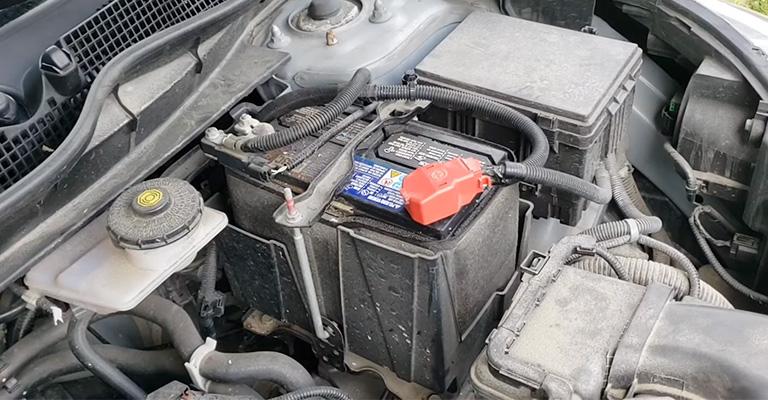
When it comes to racing on the road, the right amplifier can turn a good sound system into a competitive edge. These nine picks are engineered for maximum wattage, low distortion, and robust heat dissipation, the trifecta for racing rigs that demand reliability under the hottest conditions.
9. Orion Cobalt CBA2000.4 Amplifier

The Orion Cobalt Series CBA2000.4 is a 4‑channel Class A/B amplifier engineered for high‑end car audio. Built on a rugged chassis, it delivers a massive 2000 W peak power while maintaining a continuous 80 W RMS per channel at 2 Ω (or 50 W RMS at 4 Ω). Its MOSFET power supply provides clean, stable voltage for maximum efficiency and longevity.
Frequency response spans an impressive 10 – 30 kHz, and the integrated low‑pass, high‑pass, and bass‑boost filters let you sculpt the sound to your preference.
Dual‑mode input—low‑level RCA or high‑level ± wire—ensures seamless integration with any head unit. The amplifier also features 2‑way protection circuitry, guarding against over‑temperature, short circuits, and over‑voltage conditions so you can push the system to its limits with confidence.
The Cobalt Series’ cutting‑edge crossover design and robust construction set it apart from competitors, making it a top choice for audiophiles who demand power, clarity, and reliability in a compact unit.
Pros
- High‑output power – 2000 W peak and 80 W RMS per channel for powerful, distortion‑free sound.
- Versatile inputs – Low‑level RCA and high‑level ± wire accommodate any head unit.
- Advanced filtering – Adjustable low‑pass, high‑pass, and bass‑boost for precise tone shaping.
Cons
- High power output – Requires a strong power source; may need upgraded wiring or alternator.
- Large size – The robust chassis may take up more space than slimmer competitors.
8. AudioControl EPIC4000 Monoblock Amplifier

Experience the next level of bass performance with the AudioControl EPIC4000 Monoblock. This Class‑D powerhouse delivers a staggering 4000 W RMS at 1 Ω, engineered with a high‑current design that keeps your subwoofers fed with clean, stable power even under the most demanding loads.
The 12 dB/octave Linkwitz‑Riley low‑pass filter and variable‑frequency Epic Boost (30‑80 Hz, +0 to +12 dB) let you sculpt a ground‑shaking sound that’s perfectly tailored to your enclosure and listening space. Smart auto‑reset protection guards against overheating, clipping, and short‑circuit events, so you can play with confidence.
Integrated ACR‑E remote control and a dedicated bass knob give you instant, at‑hand adjustments without reaching for a console. Solid power terminals secured with hex screws and an included Epicenter Link make installation a breeze, while the 1 A fuse protects your gear.
Pros
- Unmatched power – 4000 W RMS @1 Ω for deep, impactful bass
- Smart protection – auto‑reset circuit prevents damage in real‑time
- Remote control – effortless on‑the‑go adjustments with ACR‑E
Cons
- Requires robust wiring – high current demands, thick, low‑resistance cabling
- Additional component needed – EPICENTER processor sold separately for full synergy
This amplifier is built for serious competition and delivers a bass experience that’s both powerful and reliable.
7. Taramps TS 400×4 Car Amplifier
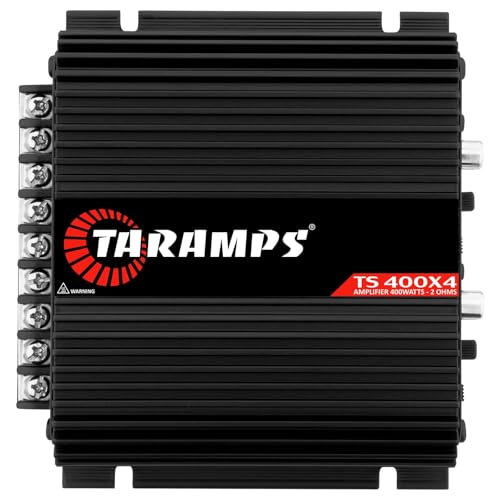
The Taramps TS 400×4 delivers a punchy 400 W RMS across four channels—100 W per channel at 2 Ω—or two bridged channels for 200 W each at 4 Ω, giving you maximum flexibility whether you’re powering a full‑size car audio system or a high‑output subwoofer setup.
Dual input options let you connect straight to a high‑level speaker feed with automatic activation, or drop in an RCA line‑level signal from any head unit—no adapters required.
The built‑in crossover system offers fixed 90 Hz high‑pass and low‑pass filters, a full‑range mode, and precise gain control, so you can fine‑tune the sound to your speakers or subwoofers. Its universal design means it’s equally suited for door speakers, subwoofers, tweeters, motorcycles, golf carts, or marine audio.
Installation is a breeze: the kit includes 11 AWG power leads, 15 AWG output wiring, 18 AWG remote leads, and a 20 A fuse rating, all specified for a professional‑grade setup.
Pros
- High‑power, versatile output – 400 W RMS with bridged mode for subwoofers
- All‑in‑one connectivity – high‑level and RCA inputs, no adapters needed
- Built‑in crossover – precise filter control for clean, balanced sound
Cons
- Requires proper wiring – 11 AWG power and 15 AWG outputs may be overkill for small systems
- Cost and complexity – higher price point for advanced features and installation hardware.
6. Skar Audio SKv2-1500.1D Subwoofer Amplifier
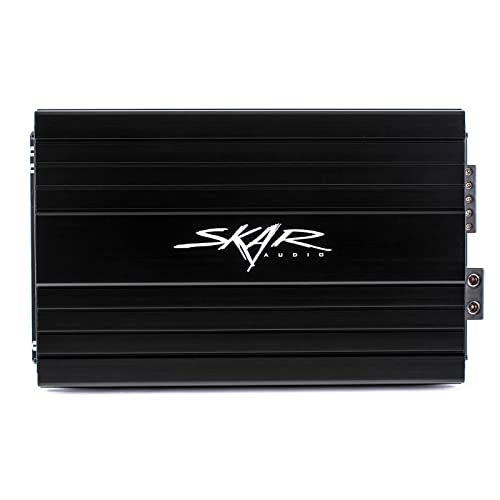
Skar Audio’s SKv2‑1500.1D is a battle‑ready, competition‑grade Class D MOSFET subwoofer amplifier that delivers an astonishing 2,200 W peak (1 Ω) and 1,500 W RMS. Built for the toughest automotive audio rigs, it stays stable at 1 Ω and covers a tight 15 Hz–270 Hz response window, giving you deep, punchy bass that never compromises clarity.
The 4‑way protection circuitry (over‑current, over‑temperature, short‑circuit, and phase‑sensitive protection) keeps the amp safe under any load, while the 1/0 gauge power and ground input terminals allow maximum current flow for those high‑power demands.
The amplifier’s user‑adjustable low‑pass filter (35 Hz–250 Hz) and remote subwoofer level control let you tailor the tone on the fly, and the on‑board bass‑boost knob (0–9 dB) gives instant, precise low‑end enhancement.
A heavy‑duty advanced heatsink design keeps temperatures down even during prolonged, high‑power operation, ensuring consistent performance and longevity.
Pros
- Unmatched power: 2,200 W peak and 1,500 W RMS at 1 Ω for maximum bass impact.
- Robust protection: 4‑way safety circuitry and heavy‑gauge wiring keep the amp safe and reliable.
- Customizable tone: Variable low‑pass filter, remote level control, and 0–9 dB bass boost.
Cons
- High power draw: Requires a strong power supply and proper grounding.
- Large heatsink: May need additional ventilation in tight vehicle compartments.
5. Power Acoustik OD1-10000D Monoblock Car Amplifier

The Power Acoustik OD1‑10000D is a single‑channel, Class D monoblock amplifier that delivers a staggering 10 000 W of clean, punchy power—enough to turn any subwoofer into a low‑frequency powerhouse.
Its Class D design keeps heat to a minimum while maintaining high efficiency, so you can push the amp hard without draining your vehicle’s electrical system.
Built to handle 1 Ω loads, the OD1‑10000D gives you the flexibility to wire multiple subwoofers in series or parallel, making it ideal for custom, high‑volume builds. Rugged construction and reliable components mean the amp will stand up to the rigors of daily driving and show‑time events alike.
Installation is a breeze; its mid‑size chassis fits comfortably in most car audio bays, and the straightforward wiring diagram keeps setup quick and hassle‑free.
Pros
- Unmatched power – 10 000 W delivers deep, concert‑level bass.
- Efficient Class D – low heat, minimal drain on your vehicle’s battery.
- 1 Ω stability – flexible wiring options for multi‑sub configurations.
Cons
- High power output – requires a robust power supply and good wiring.
- Large amp size – may need a dedicated location in some vehicles.
4. Audio360 AD6000.1 Monoblock Amplifier
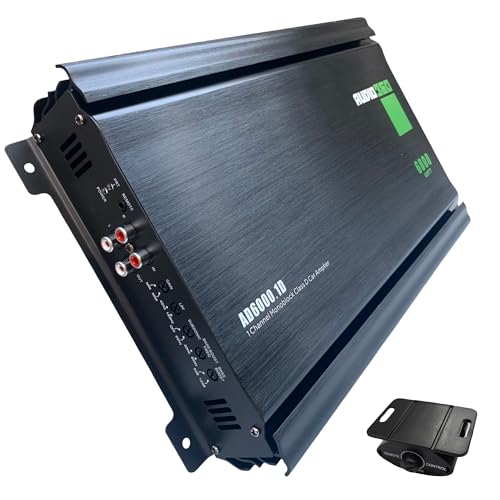
Audio360 AD6000.1 is a compact yet monstrous Class D monoblock amplifier that delivers 6000 W of peak power, making it a favorite among enthusiasts who demand explosive bass and uncompromising performance.
Its 1‑ohm stable design ensures clean, reliable output whether you’re running a single sub or a multi‑channel rig. With 91 dB SNR, the amplifier keeps distortion at bay, so every low‑frequency thump translates into crystal‑clear impact.
The unit’s 600 W @ 4 Ω, 1000 W @ 2 Ω, and 1500 W @ 1 Ω RMS ratings give you flexibility across a wide range of speaker loads, while the built‑in thermal, overload, and short‑circuit protection keep your system safe during long sessions.
The small footprint (≈13.5 × 9 × 2 in.) allows for trunk, under‑seat, or concealed installations without sacrificing power. And because it’s a Class D design, it runs cooler and more efficiently, letting you enjoy powerful bass without the heat‑up that plagues older amplifier types.
Pros
- Unmatched power: 6000 W peak and 1‑Ω stable operation for aggressive subwoofer builds.
- Clean sound: 91 dB SNR and Class D efficiency deliver distortion‑free bass.
- Versatile and safe: Multiple RMS ratings and full protection circuitry protect gear and simplify installation.
Cons
- Peak power may be overkill for casual listeners, potentially leading to unnecessary cost.
- Requires a capable power supply to harness its full 6000 W output.
3. Skar Audio SKv2-200.4D 4-Channel Car Amplifier

Experience uncompromised audio performance with the Skar Audio SKv2‑200.4D, a 4‑channel Class‑D MOSFET amplifier engineered for the demanding car audio enthusiast.
This unit delivers a peak power of 465 W per channel at 2 Ω (14.4 V) and a solid RMS rating of 320 W per channel, ensuring powerful, distortion‑free sound even at the lowest frequencies. Its 10 Hz – 40 kHz frequency response guarantees that every note from the sub‑woofer to the tweeter is rendered with clarity.
The amplifier is built with competition‑grade components, featuring 4‑way protection circuitry and 4‑gauge power/ground input terminals to handle maximum current flow safely.
User‑adjustable high‑ and low‑pass filters with x1 and x10 switches let you fine‑tune the tonal balance to match any system. A heavy‑duty advanced heatsink keeps the amp cool under load, while a 85 dB signal‑to‑noise ratio ensures clean, quiet operation.
Pros
- High power output: 465 W peak/320 W RMS per channel for crystal‑clear sound.
- Robust protection: 4‑way circuitry and 4‑gauge terminals safeguard against overload.
- Efficient cooling: Heavy‑duty heatsink keeps temperatures low during extended use.
Cons
- Large footprint: Requires ample space in the vehicle’s audio bay.
- 2 Ω demand: Optimal performance at low impedance may need matching speakers.
2. ZE1000.1 Monoblock Amplifier

The ZE1000.1 is a high‑power monoblock Class D amplifier built to deliver 2000 W maximum at 1 Ω, with 1000 W RMS at 1 Ω, 650 W RMS at 2 Ω and 400 W RMS at 4 Ω. Its Class D design keeps power loss minimal, storing excess energy until it’s needed instead of dissipating it as heat.
This results in a compact unit with a smaller heat sink and lighter weight—just 6.6 lb. The amplifier is engineered to stay stable on a 1 Ω load, making it ideal for demanding subwoofers that require a heavy power draw.
A low‑pass crossover and MOSFET power supply provide clean, efficient power delivery, while built‑in thermal, overload and short‑circuit protection keep both the car battery and the stereo safe. The compact 11” × 6.9” × 2” chassis fits easily in most automotive setups without compromising on performance.
Pros
- Unmatched power: 2000 W peak and 1000 W RMS at 1 Ω for deep, punchy bass.
- Efficient Class D: Low heat output and smaller heat sink for quieter operation.
- 1 Ω stable: Reliable performance on low‑impedance subwoofers without overheating.
Cons
- High power draw: Requires a robust battery and alternator to handle the load.
- Size/weight: Still larger than smaller stereo amps, may need careful placement.
1. STINGER MT-4000.1 Monoblock Amplifier

The STINGER Audio MT‑4000.1 is a single‑channel, 4000 W RMS monoblock designed to deliver the kind of low‑frequency punch that turns any car audio system into a mobile concert hall.
Built on a Class D topology, it achieves high efficiency while delivering monster power at 1 Ω. The amplifier is powered by a robust, pulse‑width‑modulated supply and features a high‑current 500 V capacitor that protects the Hexfet MOSFETs from surges, ensuring reliable operation even under heavy load.
A durable metal potentiometer gives you precise tonal control, while the remote‑control bass knob lets you tweak bass levels from the driver’s seat.
The built‑in bass‑boost Q lets you push up to +12 dB at a selected frequency, and the subsonic filter removes unwanted rumble. With a low‑pass filter and direct‑insert terminals, you get a clean, efficient signal path that maximizes power transfer to your subwoofer.
Pros
- Monstrous power: 4000 W RMS at 1 Ω delivers booming, distortion‑free bass.
- Efficient Class D design: Low heat output and high efficiency reduce the need for large heat sinks.
- Remote bass control: Convenient in‑seat adjustment keeps you in tune with the road.
Cons
- Single‑channel only: Requires a separate amp for higher‑frequency speakers.
- High power draw: Needs a strong 12 V supply and adequate ventilation.
Frequently Asked Questions
What amplifier power rating is ideal for car racing competitions?
The best choice for competition depends on the type of vehicle and the track length, but a 200 W RMS per channel amplifier is generally a sweet spot. It provides enough headroom for aggressive driving without overloading the speaker cabinets, and it keeps the amplifier’s thermal load manageable during long runs.
Which amplifier brand offers the most reliable performance for high‑speed racing?
JL Audio, Kenwood, and Alpine consistently rank highest for racing applications. Their amplifiers feature robust chassis construction, low distortion, and integrated thermal protection. Models like the JL Audio XD Series, Kenwood KAC‑500, and Alpine PXA‑800 are popular in racing shops for their balance of power and reliability.
How can I reduce amplifier heat buildup during a race?
- Use a high‑quality heat sink – attach a dedicated aluminum or copper heat sink to the amplifier’s power transistor area.
- Add ventilation – position the amp in a well‑ventilated compartment or install a small fan.
- Maintain proper cable gauge – use 4‑AWG or thicker power cables to minimize voltage drop and heat generation.
- Schedule rest periods – allow the amp to cool for a few minutes between laps if possible.
By following these steps, you can keep your amplifier operating within safe temperature limits and avoid performance loss during intense racing sessions.
Conclusion
Choosing the right amplifier for a competition car hinges on balancing power output with low distortion, ensuring the unit can deliver clean, punchy sound even under high load.
A headroom‑rich design protects against clipping, while robust heat dissipation and durable construction extend lifespan on the track.
Connectivity options—digital inputs, multiple speaker outputs, and remote control, add flexibility for quick tuning during races. Size and weight must fit the vehicle’s constraints without compromising airflow.
Ultimately, the best choice is one that combines proven performance, reliable build quality, and a price point that fits the team’s budget, allowing drivers to focus on speed rather than sound issues.