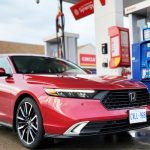
Quick answer: A current gas Honda CR-V (1.5L turbo) is EPA-rated at 30 mpg combined with front-wheel drive and 28-29 mpg with all-wheel drive. The CR-V Hybrid is rated at 40 mpg combined with FWD and 37 mpg with AWD. Older 2.4L models range from 23 mpg combined (2007) to 28 mpg combined (2017 LX).
All figures below are official EPA ratings, shown as city / highway / combined. Where we could not confirm a rating for a given year against the EPA or Honda, we left it out and point you to the lookup tool instead.

Honda CR-V MPG at a glance
CR-V MPG by model year
Ratings depend on three things: the engine, the drive type (FWD or AWD), and sometimes the trim. A dash means we could not confirm that figure.
| Model years | Powertrain | Drive | City / Highway | Combined |
|---|---|---|---|---|
| 2007-2009 | 2.4L gas | FWD | 20 / 27 (2007) | 23 |
| 2012 | 2.4L gas | FWD | — | 26 |
| 2012 | 2.4L gas | AWD | — | 25 |
| 2014 | 2.4L gas | FWD | 23 / 30 | 26 |
| 2017 | 2.4L gas (LX) | FWD | 26 / 32 | 28 |
| 2020-2022 | 1.5L turbo gas | FWD | 28 city (2020) | 30 |
| 2020-2022 | 1.5L turbo gas | AWD | — | 29 |
| 2020-2022 | Hybrid | AWD | 40 / 35 | 38 |
| 2023-2026 | 1.5L turbo gas | FWD | 28 / 34 (2024) | 30 |
| 2023-2026 | 1.5L turbo gas | AWD | 27 / 32 (2024) | 28-29 |
| 2023-2026 | Hybrid | FWD | 43 / 36 | 40 |
| 2023-2026 | Hybrid | AWD | 40 / 34 (2024) | 37 |
| 2026 | TrailSport Hybrid | AWD | 38 / 33 | 35 |
| 2027 | 1.5L turbo gas | FWD | 28 / 33 | 30 |
| 2027 | Hybrid | FWD | 43 / 36 | 40 |
Two notes on the table:
- 2007 highway rating: fueleconomy.gov lists 27 mpg highway for the 2007 FWD model, while some other references show 26. Treat it as 26-27.
- 2023-2026 gas AWD: the EPA lists 29 mpg combined for most years, and 28 mpg combined for an AWD version in 2025.
For any year not shown, including 2002-2006, look up your exact year and drive type on fueleconomy.gov. For how the numbers changed from one generation to the next, see our mileage evolution of the Honda CR-V.
Gas vs hybrid: which CR-V years have a hybrid?
In the U.S., the CR-V Hybrid first appears in EPA listings for the 2020 model year. If you see hybrid MPG figures quoted for a 2004, 2012 or 2017 CR-V, they are wrong. Those years were sold here with gas engines only.

From 2020 to 2022, the EPA lists the hybrid with AWD only, at 40 / 35 / 38 mpg. The redesigned 2023 model added a FWD hybrid rated at 43 / 36 / 40 mpg, which remains the most efficient CR-V you can buy with a gas tank.
Honda also sells the CR-V e:FCEV, a plug-in hydrogen fuel cell version. The EPA lists it at 87 MPGe combined for 2025 and 2026.
How it works: why the hybrid does better in the city
A gas CR-V gets its best mileage on the highway. The hybrid is the opposite, and the reason is how it uses energy.
Stop-and-go traffic gives the hybrid many chances to recover energy. On a long highway run it behaves more like an efficient gas car, which is why its highway rating is lower than its city rating.
FWD vs AWD: how much MPG do you lose?
AWD adds weight and drivetrain drag. On a 2024 gas CR-V the penalty is 1 mpg combined (30 vs 29). On the hybrid it is 3 mpg combined (40 vs 37). The 2026 TrailSport Hybrid is rated lower again, at 35 mpg combined.
How far can a CR-V go on a tank?
Honda lists a 14-gallon fuel tank for the 2023 CR-V. At the 30 mpg combined rating, that works out to roughly 420 miles on paper. Expect less in practice, because you will not run the tank completely dry and real-world mileage varies.
Why your real MPG is lower than the rating
EPA ratings come from standardized tests. These common factors pull real-world numbers down:
- Low tire pressure. Soft tires add rolling resistance. Set pressures to the door-jamb placard, and if the warning light stays on afterwards, here is how to reset the tire pressure light on a CR-V.
- Short trips and cold weather. A cold engine runs richer, and a hybrid runs its engine more to make cabin heat.
- High speeds and hard acceleration. Aerodynamic drag climbs quickly with speed.
- Heavy A/C use. The compressor takes engine power. A system that struggles runs longer, so fix it if your CR-V A/C is not blowing cold.
- Dragging brakes. A sticking caliper wastes fuel and overheats the wheel. See our guide to the CR-V brake system problem warning.
- Bigger wheels, roof racks and cargo boxes. If you are changing wheels, check the CR-V bolt pattern and stay close to the factory tire size.
A sharp drop with a check engine light, a fuel smell, or a wheel that is much hotter than the others is a fault, not a driving-style issue. Do not keep driving with a fuel smell or a dragging brake. Have a professional inspect it.
Other Honda MPG guides
- Honda Accord MPG
- Honda Civic MPG
- Honda Element MPG
- Honda Fit MPG
- Honda HR-V MPG
- Honda Insight MPG
- Honda Odyssey MPG
- Honda Pilot MPG
- Honda Passport MPG
- Honda Ridgeline MPG
FAQ
Which Honda CR-V gets the best gas mileage?
The front-wheel-drive CR-V Hybrid, sold from the 2023 model year. It is EPA-rated at 43 mpg city, 36 mpg highway and 40 mpg combined.
What MPG does a gas-only CR-V get?
The 2024 1.5L turbo is rated at 28 / 34 / 30 mpg with FWD and 27 / 32 / 29 mpg with AWD. The 2020-2022 models carry the same combined ratings of 30 (FWD) and 29 (AWD).
Does AWD hurt CR-V fuel economy?
Yes, slightly. On the 2024 model, AWD costs 1 mpg combined on the gas engine and 3 mpg combined on the hybrid.
Why is the CR-V Hybrid’s highway MPG lower than its city MPG?
The hybrid recovers energy every time it slows down, which helps most in city driving. At steady highway speed there is little to recover, so the gas engine carries more of the load.
What MPG does an older 2.4L CR-V get?
EPA combined ratings for FWD models are 23 mpg for 2007-2009, 26 mpg for 2012 and 2014, and 28 mpg for the 2017 LX. AWD versions are typically about 1 mpg lower. The 2012 AWD is rated at 25 mpg combined.